
Información para profesionales de la salud
Evidencia Científica
Laboratory evaluation of Drawtex Hydroconductive Dressing with LevaFiber technology.
V. Edwards-Jones, V. Vishnyakov y P. Spruce. | Manchester Metropolitan University (Escuela de Investigación, Empresa e Innovación y Escuela de Ingeniería) y TVRE Consulting, Reino Unido. | Journal of Wound Care. | Artículo de investigación técnica / Evaluación de laboratorio. | 2014.
Laboratory evaluation of Drawtex Hydroconductive Dressing with LevaFiber technology.
V. Edwards-Jones, V. Vishnyakov y P. Spruce. | Universidad de Huddersfield (Repositorio) y Manchester Metropolitan University. | Journal of Wound Care, Vol. 23, No. 3. | Artículo de investigación original / Evaluación de laboratorio. | 2014.
In Vitro Mitigation of Pathogenic Bacteria and Virulence Factors Using a Hydroconductive Dressing
Lauren T. Moffatt, Rachel T. Ortiz, Bonnie C. Carney, Rachael M. Bullock, Martin C. Robson, Marion H. Jordan y Jeffrey W. Shupp. | Firefighters’ Burn and Surgical Research Laboratory (Washington DC) y University of South Florida. | Surgical Science. | Artículo de investigación original / Estudio experimental in vitro. | 2013.
Un ensayo controlado aleatorio que compara Drawtex con apósitos estándar para heridas exudativas
S. Thomas y colaboradores | Queen’s Hospital, Burton-on-Trent y otros centros del Reino Unido. | Journal of Wound Care, Vol. 13, No. 2. | Ensayo clínico controlado aleatorio (RCT). | 2004.
A randomised controlled trial comparing Drawtex with standard dressings for exuding wounds.
S. Thomas y colaboradores | Queen’s Hospital, Burton-on-Trent y otros centros del Reino Unido. | Journal of Wound Care, Vol. 13, No. 2. | Ensayo clínico controlado aleatorio (RCT). | 2004.
Drawtex: a unique dressing that can be tailor-made to fit wounds.
Linda Russell (Especialista en Viabilidad de Tejidos) y Amanda Evans (Hermana de la Unidad de Cuidados Intensivos). | Queen’s Hospital, Burton Hospitals NHS Trust, Reino Unido. | British Journal of Nursing, Vol. 8, No. 15. | Enfoque de producto / Revisión clínica. | 1999.
In Vivo and In Vitro Evaluation of the Properties of Drawtex LevaFiber Wound Dressing in an Infected Burn Wound Model.
Rachel T. Ortiz, Lauren T. Moffatt, Martin C. Robson, Marion H. Jordan y Jeffrey W. Shupp. | MedStar Health Research Institute y The Burn Center at MedStar Washington Hospital Center, Washington, DC. | Wounds (Suplemento: Innovations for Wound Bed Preparation). | Artículo de investigación original / Estudio experimental. | 2012.
The Effect of a Hydroconductive Dressing on the Suppression of Wound Biofilm.
Randall D. Wolcott, MD. | Southwest Regional Wound Care Center, Lubbock, TX. | WOUNDS (HMP Global). | Artículo de investigación clínica / Estudio prospectivo de serie de casos. | 2012.
Treating Enterocutaneous Fistulas With a Hydroconductive Dressing.
Daphne Denham, MD. | Comprehensive Wound Care, Northbrook, IL, EE. UU. | Ostomy Wound Management (OWM), Sección «Pearls for Practice». | Reporte de caso clínico / Guía de práctica. | 2014.
A Novel Tracheostomy Dressing: Extension of a Hydroconductive Wound Dressing.
Thomas L. Wachtel, MD. | University of Arizona, Department of Surgery, Division of Trauma, Critical Care and Emergency Surgery, Tucson, AZ. | Ostomy Wound Management (OWM), Sección «Pearls for Practice». | Reporte de innovación clínica / Guía de práctica. | 2013.
Buruli Ulcer: It’s Impact and Treatment Worldwide.
Terry Treadwell, MD, FACS y John Macdonald, MD, FACS. | World Alliance for Wound and Lymphedema Care (WAWLC), Ginebra, Suiza. | Reporte de serie de casos / Análisis de impacto socioeconómico.
Buruli Ulcer: Its Impact and Treatment Worldwide: An Interval Report.
Terry Treadwell, MD, FACS y John Macdonald, MD, FACS. | Institute for Advanced Wound Care (Alabama, EE. UU.) y World Alliance of Wound and Lymphedema Care (Ginebra, Suiza). | Wounds (Suplemento: Innovations for Wound Bed Preparation). | Reporte de serie de casos / Investigación clínica en entorno de recursos limitados.
The Use of Hydroconductive Dressings to Prevent and Treat Skin Excoriation in Young Children.
June Amling, MSN, RN, CNS, CCRN, CWON (Enfermera de Práctica Avanzada). | Children’s National Health System, Washington, DC, EE. UU. | Reporte de casos clínicos. | Serie de casos clínicos pediátricos (8 casos). | 2014.
El uso innovador del apósito de vacío modificado en heridas posvulvectomía
M.A. Adam, R.P. Lebese y L. Mbodi. | Departamento de Obstetricia y Ginecología, Universidad de Witwatersrand, Sudáfrica. | Wits Journal of Clinical Medicine, Vol. 4, No. 2. | Informe de caso clínico. | 2022.
The innovative use of modified vacuum dressing in post-vulvectomy wound.
M.A. Adam, R.P. Lebese y L. Mbodi. | Department of Obstetrics and Gynaecology, School of Clinical Medicine, University of the Witwatersrand, Johannesburgo, Sudáfrica. | Wits Journal of Clinical Medicine, Vol. 4, No. 2. | Informe de caso clínico. | 2022.
Degloving facial injury treated with hydroconductive dressing.
Colin Perumal, Michael Bouckaert y Martin Robson. | Departamento de Cirugía Maxilofacial y Oral, Universidad Médica de Sudáfrica (Universidad de Limpopo) y Universidad del Sur de Florida, EE. UU. | Annals of Maxillofacial Surgery, Vol. 3, Issue 1. | Reporte de caso clínico. | 2013.
Hydroconductive Dressings Used to Heal Dehisced Incisions in Amputated Limbs: A Case Series.
Leslie A. Cnossen, RN, BSN, CWOCN y Kara S. Couch, MS, CRNP, CWS. | Walter Reed National Military Medical Center, Bethesda, MD, EE. UU. | Presentación de serie de casos (SAWC – Symposium on Advanced Wound Care). | Serie de casos clínicos. | 2013.
Using a Hydroconductive Dressing to Improve Healing in Complex Surgical Wounds.
Sue Johnson, Pam Spruce, Kathleen Leak y Denise Ridsdale. | Doncaster and Bassetlaw Hospitals NHS Foundation Trust y TVRE Consulting, Reino Unido. | Presentación de evaluación clínica. | Evaluación de serie de casos clínicos (4 pacientes). | 2012.
Use of a Hydroconductive Dressing to Treat a Traumatic Avulsive Injury of the Face.
Colin Jerome Perumal, BDS y Martin Robson, MD. | Medical University of South Africa (MEDUNSA) y University of South Florida, EE. UU. | ePlasty (Open Access Journal de Cirugía Plástica). | Reporte de caso clínico (Cirugía Maxilofacial). | 2012.
Un estudio prospectivo, controlado en el mismo paciente para comparar la capacidad del apósito hidroconductor no adherente Drawtex® con un apósito de película de poliuretano transparente (estándar de atención) en la curación de sitios donantes de injertos de piel de espesor parcial.
Barend H. Van den Bergh, Deirdré Kruger, Jonathan Kourie, Steve Moeng y Martin C. Robson. | División de Cirugía Plástica y Reconstructiva, Universidad de Witwatersrand, Johannesburgo (Sudáfrica) y Universidad del Sur de Florida (EE. UU.). | Surgical Science, Vol. 9. | Ensayo clínico prospectivo, aleatorizado y controlado (intra-paciente). | 2018.
A Prospective, Within-Patient Controlled Study to Compare the Ability of the Non Adherent Drawtex® Hydroconductive Dressing to a Transparent Polyurethane Film Dressing (Standard of Care) on the Healing of Split-Thickness Skin Graft Donor Sites
Barend H. Van den Bergh, Deirdré Kruger, Jonathan Kourie, Steve Moeng y Martin C. Robson. | University of the Witwatersrand (Sudáfrica) y University of South Florida (EE. UU.). | Surgical Science, Vol. 9. | Ensayo clínico prospectivo, aleatorizado y controlado (intra-paciente). | 2018.
Optimising Wound Bed Conditions in Diabetic Foot Ulcers Using Hydroconductive Debridement Dressings.
Ian Wilson y Terrence Gorvett (Podólogos especialistas en Diabetes). | University Hospitals Birmingham NHS Foundation Trust y Abertawe Bro Morgannwg University Health Board, Reino Unido. | Reporte de evaluación clínica. | Evaluación clínica de serie de casos (4 pacientes). | 2014.
The Management of Acid Burns in a South African Hospital (44-Battery-Acid-Burns-Treatment-with-Drawtex).
Howard Kingu (Cirujano Plástico), Portia Gaju (Cirujana Plástica) y Pam Spruce (Consultora TVRE). | Nelson Mandela Academic Hospital. | Eastern Cape, Sudáfrica. | Reporte de caso clínico. | 2013.
Reduction of a Multidrug-Resistant Pathogen and Associated Virulence Factors in a Burn Wound Infection Model: Further Understanding of the Effectiveness of a Hydroconductive Dressing.
Bonnie C. Carney, Rachel T. Ortiz, Rachael M. Bullock, Nicholas J. Prindeze, Lauren T. Moffatt, Martin C. Robson y Jeffrey W. Shupp. | Firefighters’ Burn and Surgical Research Laboratory, MedStar Health Research Institute, Washington, DC. | Eplasty (Open Access Journal). | Artículo de investigación original / Estudio experimental in vivo. | 2014.
A Prospective, Internally-controlled Study to Compare the Absorbent Capability of a Hydroconductive Dressing Versus the Standard Gauze Burn Dressing on Partial Thickness Burns (CR-39).
Rachel Karinoski PhD, Collin Sprenker BS, Martin C. Robson MD, Wayne Cruse MD, Kim S. Brown ARNP y David J. Smith MD. | Departamento de Cirugía, Universidad del Sur de Florida (USF Health) y Unidad de Quemados del Tampa General Hospital, Florida, EE. UU. | Ensayo clínico prospectivo y controlado internamente | 2012.
A retrospective analysis of Drawtex hydroconductive dressing compared with standard silver sulphadiazine mixed with a hydrogel, in an adult provincial tertiary burn centre in the Western Cape Province, South Africa.
Wayne George Kleintjes, Hilde du Plooy y Edwin Peter Kotzee. | Western Cape Provincial Tertiary Adult Burn Unit, Division of Surgery, Tygerberg Hospital y Stellenbosch University, Ciudad del Cabo, Sudáfrica. | South African Journal of Plastic & Reconstructive Aesthetic Surgery & Burns (SAJPRASB). | Artículo de investigación original / Estudio retrospectivo comparativo. | 2019
Reduction of a Multidrug-Resistant Pathogen and Associated Virulence Factors in a Burn Wound Infection Model: Further Understanding of the Effectiveness of a Hydroconductive Dressing.
Bonnie C. Carney, Rachel T. Ortiz, Rachael M. Bullock, Nicholas J. Prindeze, Lauren T. Moffatt, Martin C. Robson y Jeffrey W. Shupp. | Firefighters’ Burn and Surgical Research Laboratory, MedStar Health Research Institute, Washington, DC; University of South Florida y The Burn Center, MedStar Washington Hospital Center. | Eplasty (An Open Access Journal). | Artículo de investigación original / Estudio experimental in vivo. | 2014.
Reduction of Multi-Drug Resistant Pathogens and Associated Virulence Factors in a Burn Wound Infection Model: Further Understanding of the Effectiveness of a Hydroconductive Dressing.
Lauren T. Moffatt PhD, Rachel T. Ortiz MS, Martin C. Robson MD y Jeffrey W. Shupp MD. | Firefighters’ Burn and Surgical Research Laboratory, MedStar Health Research Institute (Washington DC) y University of South Florida (Tampa FL). | Resumen de investigación experimental / Póster científico. | 2014.
The Treatment of Partial-Thickness Burns with a Hydroconductive Wound Dressing: Clinical and Mechanistic Effects.
David J. Smith, Rachel A. Karlnoski, Ami Patel, C. Wayne Cruse, Kimberly S. Brown y Martin C. Robson. | Departamento de Cirugía, Universidad del Sur de Florida (USF) y Tampa General Hospital Burn Center, Tampa, EE. UU. | Surgical Science, Vol. 4, No. 5. | Ensayo clínico prospectivo y controlado internamente. | 2013.
Clinical Practice Evaluation and Usage of a Novel Absorbent Dressing.
Dot Weir, RN, CWON, CWS y Melodie Blakely, PT, MS, CWS. | Osceola Regional Medical Center y SteadMed Technologies. | Evaluación de práctica clínica con reporte de casos. | Circa 2011-2012.
Innovations for Wound Bed Preparation: The Role of Drawtex Hydroconductive Dressings.
Martin C. Robson, MD (Editor/Moderador) y un panel de investigadores (Ortiz, Moffatt, Shupp, Ochs, Wolvos, Wendelken, Wolcott, entre otros). | Simposio de Investigadores (Tampa, FL) con la participación de la Universidad del Sur de Florida, MedStar Health Research Institute y Southwest Regional Wound Care Center. | Suplemento de la revista WOUNDS. | Compendio de múltiples estudios (clínicos, in vivo e in vitro). | 2012
Drawtex: Rompiendo el círculo vicioso de desequilibrios celulares y moleculares
Annemarie Brown y Mandy Yorke. | Tissue Viability Solutions y Solent NHS Trust, Reino Unido. | British Journal of Community Nursing. | Artículo de revisión clínica y análisis de costo-beneficio. | 2013.
Drawtex: breaking the vicious circle of cellular and molecular imbalances.
Annemarie Brown y Mandy Yorke. | Tissue Viability Solutions y Solent NHS Trust, Reino Unido. | British Journal of Community Nursing (BJCN), Vol. 18, No. 12 (Product Focus). | Artículo de revisión clínica y análisis de gestión sanitaria. | 2013.
Drawtex Hydroconductive Dressing – Removing All the Barriers – A 10 patient Evaluation in the Acute Care Setting.
Lindsey Bullough (Enfermera de Viabilidad de Tejidos) y Pam Spruce (Directora Clínica). | Wrightington Wigan and Leigh NHS Trust y TVRE Consulting, Reino Unido. | Evaluación clínica de serie de casos (10 pacientes). | 2013.
Hydroconductive debridement Made Easy.
Lindsey Bullough. | Wrightington, Wigan and Leigh NHS Foundation Trust, Reino Unido. | Wounds UK, Volumen 10, Número 2. | Guía de mejores prácticas / Artículo educativo técnico. | 2014.
Objective Quantitative Analysis of Wound Bed Preparation for Pressure Ulcers and Venous Leg Ulcers Utilizing a Hydroconductive Wound Dressing.
Jacques Goosen, Philadi Mashiane, Tebogo Mokopanele, Maude Snyders, Yungu M. Ndjo y Nellie Lambrecht. | Charlotte Maxeke Hospital (Johannesburgo), Steve Biko Hospital (Pretoria), Leratong Hospital y Montana Hospital, Southafrica. | Ostomy Wound Management (OWM), Vol. 59, No. 4. | Estudio clínico descriptivo con análisis cuantitativo de imagen. | 2013.
Successful Debridement of a Necrotic Heel Using Hydroconductive Debridement Dressings in a Care Home Environment.
Espie Yoro, Clinical Lead Nurse. | Ty Mawr Nursing Home, Ystradgynlais, Swansea, Gales, Reino Unido. | Reporte de caso clínico apoyado por Martindale Pharma. | Reporte de caso clínico / Póster de evaluación. | 2014.
Manejo de fluidos en heridas: el rol de un apósito hidroconductor
Tom Wolvos, MS, MD, FACS y Matthew Livingston, RN, BSN, CWS, ACHRN. | Scottsdale Healthcare Osborn Medical Center (Scottsdale, AZ) y Paradise Valley Wound Center (Paradise Valley, AZ), EE. UU. | WOUNDS, Vol. 25, No. 1. | Serie de casos clínicos (8 pacientes). | 2013.
Wound Fluid Management in Wound Care: The Role of a Hydroconductive Dressing.
Tom Wolvos, MS, MD, FACS y Matthew Livingston, RN, BSN, CWS, ACHRN. | Scottsdale Healthcare Osborn Medical Center (Scottsdale, AZ) y Paradise Valley Wound Center (Paradise Valley, AZ), EE. UU. | WOUNDS, Vol. 25, No. 1. | Serie de casos clínicos (8 pacientes). | 2013.
Management of Complex Lower Limb Wounds Using a Hydroconductive Debridement Dressing.
Emma Drinkall y Rebecca Thomas. | Tissue Viability Nurse y Community Nurse, South West Yorkshire Partnership NHS Foundation Trust, Reino Unido. | Evaluación clínica de serie de casos (6 pacientes). | 2014.
Management of Chronic Venous Leg Ulcers Using a Hydroconductive Debridement Dressing.
Denise Wilson (Surgical Care Practitioner). |University Hospitals of Morecambe Bay NHS Trust, Lancaster, Reino Unido. | Evaluación clínica de serie de casos (3 pacientes). | 2014.
Detoxification of Venous Ulcers With a Novel Hydroconductive Wound Dressing That Absorbs and Transports Chronic Wound Fluid Away From the Wound.
Martin Wendelken DPM, RN; Phillip Lichtenstein, BS; Kathryn DeGroat, BS; Oscar M. Alvarez, PhD. | Center for Curative and Palliative Wound Care, Calvary Hospital (Bronx, NY) y New York Medical College. | Estudio clínico prospectivo con análisis bioquímico. | 2012.
Hydroconductive Debridement: A New Perspective in Reducing Slough and Necrotic Tissue.
Matthew W. Livingston, RN, BSN, CWS, ACHRN y Tom A. Wolvos, MS, MD, FACS. | Scottsdale Healthcare Osborn Medical Center y Paradise Valley Wound Center, Arizona, EE. UU. | Serie de casos clínicos (8 pacientes) | 2013.
Wound Fluid Management in Wound Care: The Role of a Hydroconductive Dressing.
Tom Wolvos, MS, MD, FACS y Matthew Livingston, RN, BSN, CWS, ACHRN. | Scottsdale Healthcare Osborn Medical Center (Scottsdale, AZ) y Paradise Valley Wound Center (Paradise Valley, AZ), EE. UU. | WOUNDS, Vol. 25, No. 1. | Serie de casos clínicos (8 pacientes). | 2013.
Using Hydroconductive Dressings on Wounds Where Healing is Delayed due to Steroid or Immunosuppression Therapy.
Daphne Denham, MD. | Comprehensive Wound Care, LLC, Libertyville, IL, EE. UU. | Ostomy Wound Management (OWM), Sección «Pearls for Practice». | Reporte de casos clínicos / Guía de práctica. | 2013.
Información técnica del producto
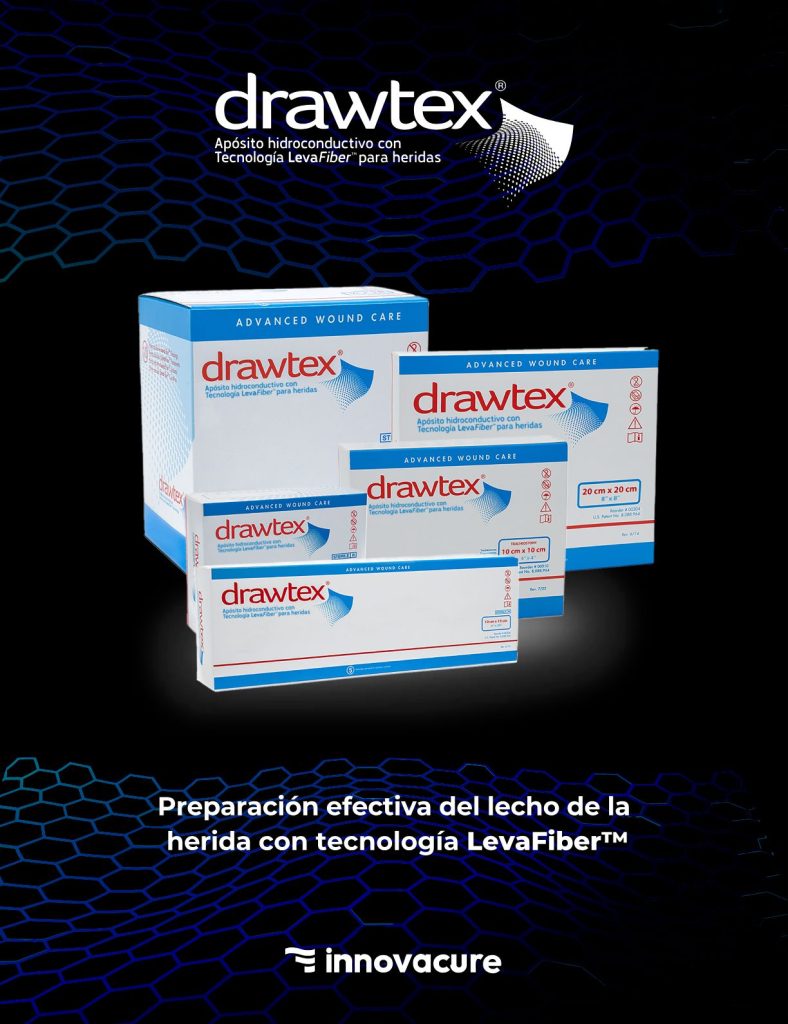
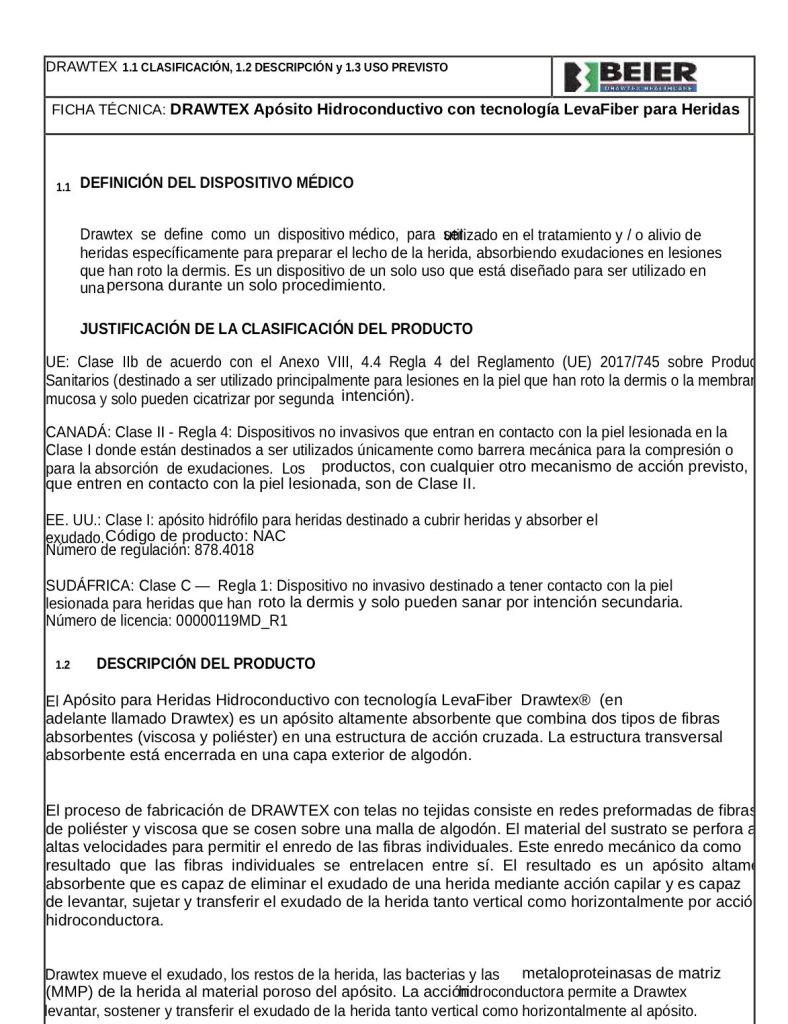

Preparación efectiva del lecho de la herida con tecnologia Levafiber™

Extrae eficientemente el exudado (hasta 150 cc/h), ayudando a controlar la humedad y reducir formación de biofilm
Permite aplicación en capas para potenciar su acción hidroconductiva.
Contribuye a la limpieza del lecho, disminuyendo la carga bacteriana, incluso en presencia de bacterias resistentes como SARM.