
Información para profesionales de la salud
Evidencia Científica
The use of hypochlorous acid in an irradiation ulcer of the lower eyelid – a case study.
H. Roos y B. Kana. | Trifectiv (Pty) Ltd y Universidad de Witwatersrand. | Wound Healing Southern Africa (Medpharm). | Sudáfrica. | Reporte de caso clínico | 2021.
Evaluation of Vashe Wound Therapy in the Clinical Management of Patients with Chronic Wounds.
Jeffrey A. Niezgoda, MD; Peter J. Sordi, MD; y Michel H.E. Hermans, MD. | St Luke’s Medical Center (Milwaukee, WI) y Southside Hospital (Bay Shore, NY). | Advances in Skin & Wound Care. | Investigación original | 2010.
The Immediate and Delayed Post-Debridement Effects on Tissue Bacterial Wound Counts of Hypochlorous Acid Versus Saline Irrigation in Chronic Wounds.
John M. Hiebert, MD y Martin C. Robson, MD. | Truman Medical Center (University of Missouri-Kansas City) y University of South Florida. |ePlasty (Distribuido por URGO Medical).| Artículo de investigación clínica | 2016.
Preparación del lecho de la herida: limpieza segura y eficaz con ácido hipocloroso pH 5.5.
B. A. Delgado y C. L. González | Laboratorio Urgo Medical Chile | Revista de Educación en Salud / Urgo Medical. | Artículo de revisión técnica y educación en salud. | 2021.
Evaluation of Vashe Wound Therapy in the Clinical Management of Patients with Chronic Wounds.
Jeffrey A. Niezgoda, MD; Peter J. Sordi, MD; y Michel H.E. Hermans, MD. | St Luke’s Medical Center (Milwaukee, WI) y Southside Hospital (Bay Shore, NY). | Advances in Skin & Wound Care. | Artículo de investigación original / Estudio clínico prospectivo. | 2010.
Hypochlorous Acid: An Ideal Wound Care Agent With Powerful Microbicidal, Antibiofilm, and Wound Healing Potency.
Serhan Sakarya, MD; Necati Gunay, MS; Meltem Karakulak, MS; Barcin Ozturk, MD; Bulent Ertugrul, MD. | Universidad Adnan Menderes, Facultad de Medicina. | Wounds: A Compendium of Clinical Research and Practice. | Aydın, Turquía. | Artículo de investigación original / Estudio experimental in vitro. | 2014.
Hypochlorous-Acid-Generating Electrochemical Scaffold for Treatment of Wound Biofilms.
Mia Mae Kiamco, Hannah M. Zmuda, Abdelrhman Mohamed, Douglas R. Call, Yash S. Raval, Robin Patel y Haluk Beyenal. | Washington State University y Mayo Clinic. | Scientific Reports (Nature Publishing Group). | Artículo de investigación técnica / Ingeniería biomédica. | 2019.
Eficacia y seguridad del ácido hipocloroso pH 5,5 en el manejo de heridas complejas en usuarios pediátricos.
Varios especialistas de centros de salud en Santiago. | Santiago, Chile. | Journal of Wound Care (JWC LATAM). | Serie de casos clínicos / Artículo de práctica clínica. | 2024
The Safe Use of Pure Hypochlorous Acid as a Cleanser of Skin and Wounds on the Premature Infant.
Ferne T. Elsass, MSN, RN, CPN, CWON. | Children’s Hospital of The King’s Daughters, Norfolk, VA. | Journal of Wound Care (JWC LATAM). | Póster de Investigación Clínica / Presentación de Casos. |
The Safe Use of Pure Hypochlorous Acid as a Cleanser of Skin and Wounds on the Premature Infant.
Ferne T. Elsass, MSN, RN, CPN, CWON. | Children’s Hospital of The King’s Daughters, Norfolk, Virginia. | SAWC Spring (Symposium on Advanced Wound Care). | Póster científico / Serie de casos clínicos. | 2018.
Cost-analysis of universal decolonization with pure hypochlorous acid and mupirocin to reduce MRSA infections in intensive care burn unit patients.
Peter J. Mallow, PhD; Deepti Chakravarthy, PhD; y Kevin Foster, MD, MBA. | Xavier University (Cincinnati, OH) y Valleywise Health Medical Center (Phoenix, AZ). | Frontiers in Pharmacology. | Informe de investigación breve / Análisis de costos y efectividad. | 2025.
Randomized Comparison of Hypochlorous Acid With 5% Sulfamylon Solution as Topical Therapy Following Skin Grafting.
Kevin N. Foster, MD, MBA; K. J. Richey, BSN, RN; J. S. Champagne, MA, RN; y M. R. Matthews, MD. | The Arizona Burn Center at Maricopa Integrated Health System, Phoenix, AZ. | ePlasty (Open Access Journal). | Artículo de investigación original / Estudio clínico aleatorizado | 2019.
Universal Decolonization with Hypochlorous Solution in a Burn Intensive Care Unit in a Tertiary Care Community Hospital.
Dorinne Gray, Kevin Foster, Abner Cruz, Gail Kane, Mike Toomey, Curtis Bay, Patricia Kardos y Gholamabbas Amin Ostovar. | Arizona Burn Center y Maricopa Integrated Health System, Phoenix, AZ. | Reporte clínico distribuido por URGO Medical. | Estudio retrospectivo / Análisis de intervención clínica. | 2017.
Vashe® Wound Therapy versus Sulfamylon® in the management of grafted burns: results of a pilot study.
K. N. Foster, V. L. Tanner, K. J. Richey, M. A. Pressman, J. S. Champagne, M. D. Peck y D. M. Caruso. | Arizona Burn Center, Maricopa Integrated Health Systems, Phoenix, AZ. | Presentado originalmente en el 42nd Annual American Burn Association Meeting; distribuido por URGO Medical. | Informe de ensayo clínico / Estudio piloto. | 2012.
Caso clínico: Manejo de úlcera compleja con solución de ácido hipocloroso (Vashe®).
Equipo clínico de Urgo Medical | Centro de atención especializada en heridas | Santiago, Chile. | Reporte de caso clínico / Material educativo de Urgo Medical. | 2024.
Healing Exposed Calvarial Hardware Using Hypochlorous Acid: A Case Report.
Mark R. Matthews, MD; Kevin N. Foster, MD, MBA; Anne G. Hunter, MD; Kathleen J. Richey, RN, BSN. | Arizona Burn Center, Maricopa Integrated Health System, Phoenix, AZ. | Journal of Burn Care & Research (Oxford University Press). | Reporte de caso clínico. | 2018.
A Case Review Series of Negative Pressure Wound Therapy with Instillation and Dwell Time (NPWTi-d) with Hypochlorous Acid (HOCl) Versus Sodium Hypochlorite (NaOCl) or 0.9% Saline Instillation in Complex, Infected Wounds.
Robert Felte, MD; Kathy Gallagher, DNP; Luis Cardenas, MD, PhD; y Mark Cipolle, MD, PhD. | ChristianaCare, Newark, Delaware (EE. UU.). | Distribuido por URGO Medical | Serie de casos clínica / Estudio observacional retrospectivo. | 2020.
A Randomized Clinical Trial: The Efficacy of Hypochlorous Acid on Septic Traumatic Wound.
Mimi M. Mekkawy, PhD y Ahmed Kamal, MD. | Universidad de Assiut, Facultad de Enfermería y Facultad de Medicina | Journal of Education and Practice. | Assiut, Egipto. | Artículo de investigación original | 2014.
Salvage of Infected Orthopedic Hardware With Intraoperative and Postoperative Hypochlorous Acid Instillations.
Eric Clayman, MD; Zackery Beauchamp, BS; Jared Troy, MD. | Division of Plastic and Reconstructive Surgery, University of Wisconsin-Madison. | ePlasty (ISSN 1937-5719) | Madison, Wisconsin. | Reporte de casos clínicos | 2023.
Comparing the Efficacy and Rates of Adverse Outcomes of Vashe to Standard Isotonic Saline for Irrigation in Orthopaedic Trauma Surgery.
Brent A. Prenger; James L. Cook; Douglas R. Haase; Kyle M. Schweser; Mauricio Kfuri; James P. Stannard; Gregory J. Della Rocca; Brett D. Crist. | Thompson Laboratory for Regenerative Orthopaedics, University of Missouri. | Journal of Orthopaedic Science and Research (E-ISSN: 3068-3726). | Artículo de investigación original | 2026.
The Efficacy of Negative Pressure Wound Therapy and Antibiotic Beads in Lower Extremity Salvage.
Karen E. Burtt, MD; Ido Badash, BA; Hyuma A. Leland, MD; Daniel J. Gould, MD, PhD; Alexis D. Rounds, MD; Ketan M. Patel, MD; y Joseph N. Carey, MD. | Keck School of Medicine of USC (Los Ángeles) y Mount Sinai Medical Center | Miami Beach, Florida | Los Angeles, California | Boston, Massachusetts | Journal of Surgical Research (Elsevier). | Artículo de investigación original | 2019.
Hypochlorous Acid as a Potential Wound Care Agent. Part I. Stabilized Hypochlorous Acid: A Component of the Inorganic Armamentarium of Innate Immunity.
Wang L, Bassiri M, Najafi R, Najafi K, Yang J, Khosrovi B, Hwong W, Barati E, Belisle B, Celeri C, y Robson MC. | NovaBay Pharmaceuticals, Inc. e Institute for Tissue Regeneration, Repair and Rehabilitation. | Journal of Burns and Wounds. | Artículo de investigación técnica y biológica. | 2007.
Hypochlorous Acid as a Potential Wound Care Agent. Part II. Stabilized Hypochlorous Acid: Its Role in Decreasing Tissue Bacterial Bioburden and Overcoming the Inhibition of Infection on Wound Healing.
Martin C. Robson, MD; Wyatt G. Payne, MD; Francis Ko, BS; Marni Mentis, DO; Guillermo Donati, DPM; Susan M. Shafii, MD; Susan Culverhouse, MD; Lu Wang, PhD; Behzad Khosrovi, PhD; Ramin Najafi, PhD; Diane M. Cooper, PhD; y Mansour Bassiri, PhD. | Institute for Tissue Regeneration, Repair and Rehabilitation (Bay Pines, FL); University of South Florida; NovaBay Pharmaceuticals; y Healthpoint Ltd. | Journal of Burns and Wounds. | Artículo de investigación original, Estudio experimental en modelo animal. | 2007.
Treating Chronic Wounds With Hypochlorous Acid Disrupts Biofilm.
Martin C. Robson, MD (Profesor emérito de cirugía, Universidad del Sur de Florida). | Today’s Wound Clinic (HMP Global). | Artículo de revisión técnica y resultados de estudio. | 2014.
Wound Cleansing: Benefits of Hypochlorous Acid (Supplement).
Publicado en asociación con Mölnlycke Health Care. | Wounds UK / Wounds International. | Suplemento científico. | 2020.
Información técnica del producto
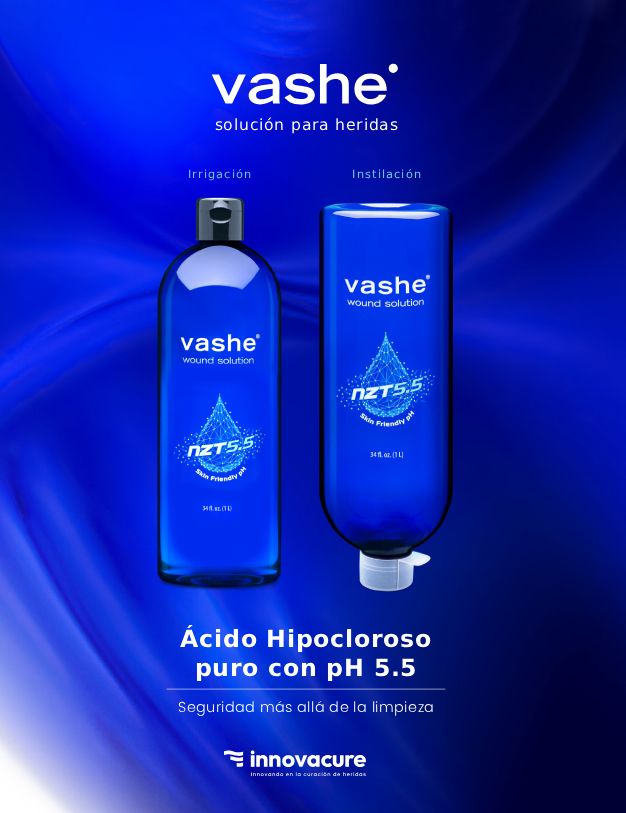
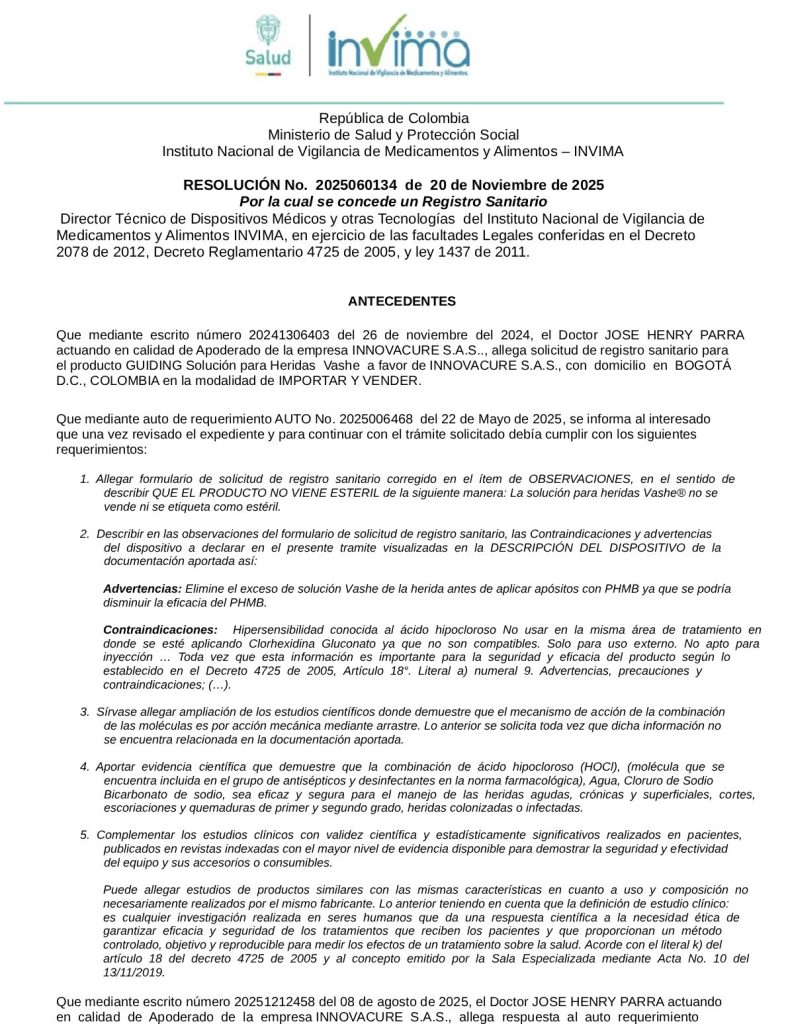
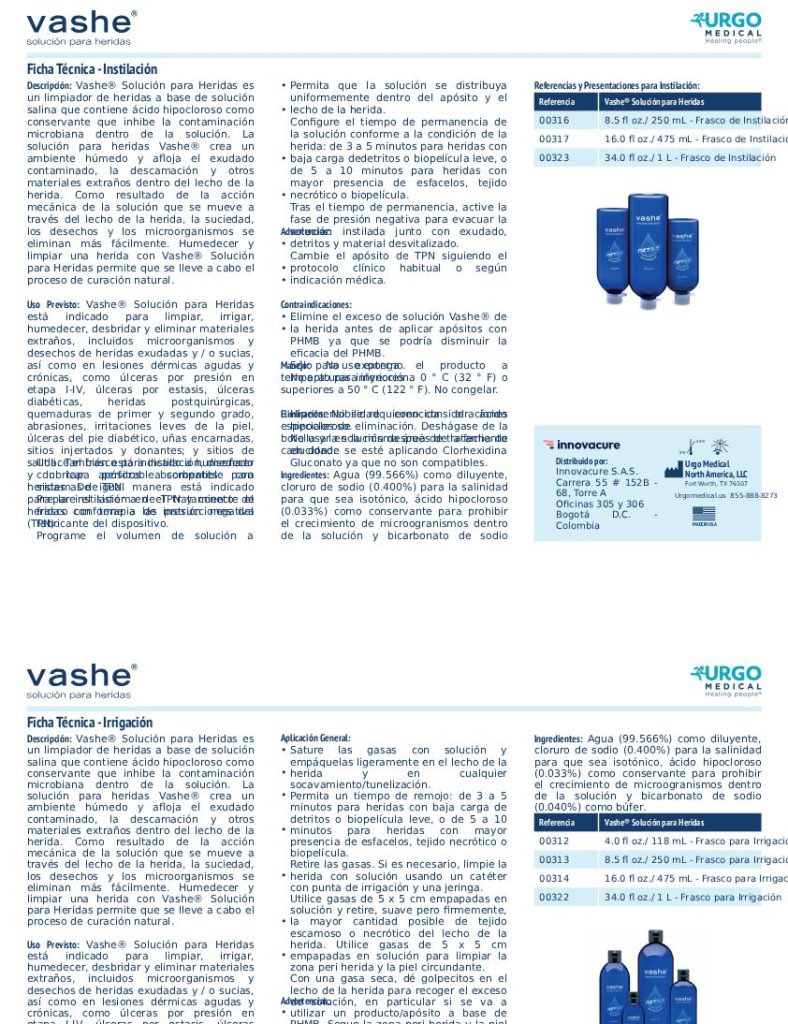

Vashe® Ácido hipocloroso puro con pH 5.5

Acción antimicrobiana, limpia y desinfecta en pocos segundos.
Es una solución no citotóxica, segura para todas las edades y tejidos.
Desbridamiento y limpieza, elimina de forma suave el material extraño.
Efectividad 80-100 veces mayor que el hipoclorito de sodio.